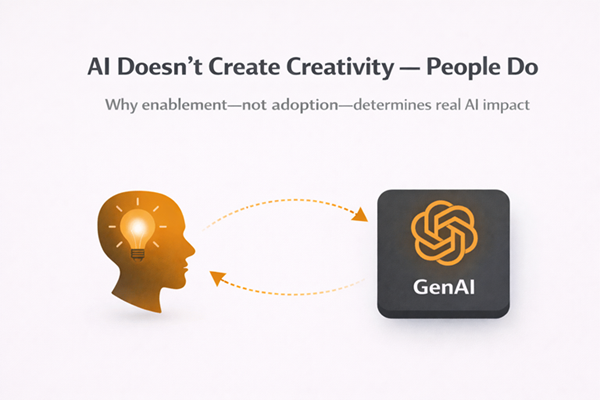
AI Doesn’t Create Creativity — People Do
A Data Tribes perspective on enablement, amplification, and responsible AI adoption
Generative AI is no longer an experimental technology sitting on the sidelines of organizations. It is embedded in daily workflows, quietly reshaping how employees write, analyze, summarize, design, and ideate. Tools such as ChatGPT are now widely accessible, and many leaders assume that creativity, innovation, and productivity will naturally follow.
Yet a recent article published by Harvard Business Review (click here to view article) reveals a striking contradiction: while generative AI adoption is growing rapidly, only a small fraction of employees report meaningful creative gains. According to cited research, just 26% of employees using generative AI feel that it has improved their creativity.
This gap between expectation and reality is not a technology problem. It is a leadership, enablement, and capability problem.
At Data Tribes, we see this pattern repeatedly across industries: organizations rush to adopt AI tools, but few stop to ask how these tools are actually being used, who is benefiting from them, and whether they are amplifying human potential or simply accelerating existing habits.
AI Does Not Create Creativity — It Reveals It
The core insight of the research is both powerful and uncomfortable: generative AI does not make everyone more creative. Instead, it tends to magnify existing cognitive behaviors.
Employees with strong metacognition, the ability to plan, monitor, evaluate, and refine their thinking, consistently benefit from AI. They treat AI as a thinking partner: questioning outputs, asking for alternatives, challenging assumptions, and iterating on ideas. For them, AI expands cognitive capacity and unlocks new perspectives.
By contrast, employees with weaker metacognitive habits often accept AI outputs at face value. They rely on default responses, rarely validate results, and struggle to translate AI suggestions into meaningful creative outcomes. In these cases, AI becomes a shortcut rather than an amplifier.
We always inform our clients that
"AI does not replace thinking — it exposes the quality of thinking already in place."
AI is not a creativity engine on its own. It is a multiplier. And like any multiplier, it amplifies both strengths and weaknesses.
A Leadership Wake-Up Call: Three Questions That Matter
One of the strongest messages leaders should take from this research is that AI adoption without reflection is a false victory. At Data Tribes, we believe this moment calls for leadership self-assessment, grounded in three critical questions:
- Are you truly enabling your employees, or just deploying tools?
Rolling out GenAI licenses does not equate to empowerment. Without guidance, structure, and shared practices, AI becomes another disconnected system rather than a capability enabler. - Do you actually know how your teams are using GenAI?
Are employees using AI to explore ideas, challenge assumptions, and enhance judgment, or merely to rewrite emails and summarize documents faster? - Are you measuring impact before and after GenAI adoption?
Few organizations define KPIs that assess changes in decision quality, creativity, or problem-solving effectiveness. Without measurement, AI value remains anecdotal.
These questions are uncomfortable, but necessary. Organizations that avoid them risk mistaking activity for impact.
From Saving Time to Amplifying Impact
Most GenAI strategies today focus on efficiency: reducing manual effort, automating repetitive tasks, and accelerating delivery timelines. While this is valuable, it is not transformative.
At Data Tribes, we make a clear distinction between saving time and amplifying value.
- Saving time reduces effort.
- Amplifying value elevates outcomes.
Removing tedious tasks is necessary, but insufficient. The real opportunity lies in using AI to:
- Expand thinking horizons
- Improve decision quality
- Enable deeper analysis
- Encourage exploration of alternatives
When AI is used only as a productivity shortcut, organizations cap its value early. When it is used as a cognitive amplifier, it reshapes how work is done.
Enablement Is Not Optional
The research makes one thing clear: metacognition is not evenly distributed across employees. But at Data Tribes, we strongly believe this should not be interpreted as a talent limitation. It is an enablement challenge.
Metacognitive skills can be:
- Developed
- Practiced
- Reinforced through design
Organizations that expect consistent AI value must invest in intentional enablement, not passive adoption. This includes:
- Training employees to question AI outputs
- Teaching structured prompting and iteration
- Embedding reflection into workflows
Encouraging validation and alternative exploration
AI capability does not emerge organically. It must be cultivated.
This is where Data Tribes positions itself clearly — as an enablement partner, not a tool vendor. Our focus is on helping organizations and professionals:
- Build AI-ready mindsets
- Develop reflective and responsible AI practices
- Amplify human thinking rather than replace it
At Data Tribes, we believe AI value is unlocked through people. Our community, courses, and enablement programs are designed to help individuals and organizations build the skills, mindset, and practices required to work with AI thoughtfully, effectively, and responsibly.
If this topic resonates with you, you can explore our content and join the Data Tribes community here: Register on the Data Tribes website
Collaborative Intelligence, Not AI Dependency
While the promise of GenAI is compelling, its risks are equally real. Hallucinations, factual inaccuracies, and misleading outputs are not edge cases — they are structural characteristics of generative systems.
We have already seen well-known organizations face reputational damage and regulatory penalties due to unchecked AI usage in deliverables. These incidents are not failures of AI technology; they are failures of governance and human oversight.
From a Data Tribes perspective, the future is not about AI autonomy. It is about collaborative intelligence — where humans remain accountable, critical, and in control.
AI should:
- Support judgment, not replace it
- Challenge thinking, not override it
- Accelerate insight, not bypass responsibility
Human-in-the-loop must be a designed principle, not a hopeful assumption.
What This Means for AI Readiness and Strategy
When viewed holistically, this research reinforces a broader truth: AI readiness is not purely technical.
True readiness spans across people & culture, which is at the heart of our AI Readiness framework (check our article for more information)
Organizations that succeed with AI do not ask, “Which tools should we adopt?”
They ask, “Which capabilities must we build?”
AI maturity is achieved not when tools are deployed, but when people can use them wisely, critically, and creatively.
References used for this article:
HBR - Why AI Boosts Creativity for some Employees but not Others
Gallop - AI in the Workplace, Answering 3 Big Questions
APA PsycNet - How and for Whom Using Generative AI Affects Creativity - A Field Experimet