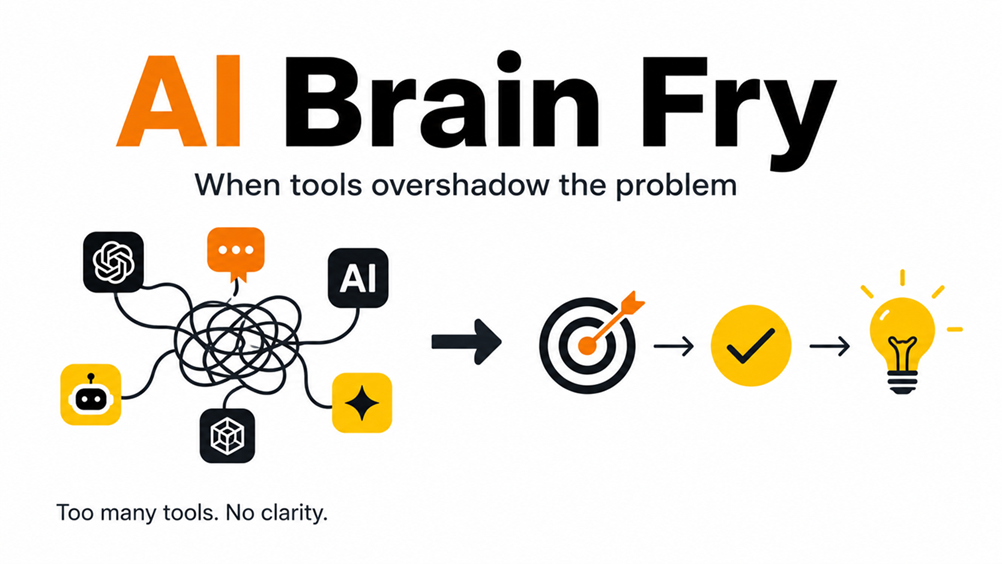
AI Brain Fry: When We Work Harder to Manage the Tools Than to Solve the Problem
AI was supposed to make work easier.
It was supposed to help us summarize faster, write better, automate routine tasks, make smarter decisions, and reduce the burden of repetitive work. And in many cases, it does exactly that.
But a new term has started to capture something many employees are quietly experiencing: AI brain fry.
The term refers to the mental fatigue that comes from excessive use or oversight of AI tools beyond one’s cognitive capacity. In simple terms, it is what happens when people are not just using AI to support their work, but are constantly supervising it, correcting it, switching between tools, comparing outputs, validating results, and trying to keep up with a workflow that has become more cognitively demanding than the original task.
The irony is hard to miss.
In some cases, employees are working harder to manage the tools than to actually solve the problem.
And that is where the real issue begins.
The Problem Is Not AI Adoption. The Problem Is Problem-Blind AI Adoption
The danger is not AI adoption.
The danger is adopting AI as an activity rather than as a response to a clearly understood problem.
Many organizations are pushing teams to “use AI” because AI has become a strategic priority. Leaders want to see adoption. Teams want to demonstrate progress. Employees want to show they are keeping up. Vendors are introducing new tools every week. Every workflow suddenly looks like a candidate for automation, orchestration, agents, copilots, or AI-enabled redesign.
But somewhere in that rush, a very basic question can get lost:
What problem are we actually trying to solve?
When that question is unclear, AI can become a distraction rather than an enabler. Teams begin experimenting with tools before defining the challenge. They create workflows before understanding the bottleneck. They automate steps before asking whether those steps should exist in the first place. They compare platforms, agents, prompts, and integrations without agreeing on what value they are trying to create.
This is when AI becomes another layer of work.
Instead of reducing complexity, it adds more of it.
When AI Becomes Cognitive Load
The promise of AI is productivity. But productivity does not come automatically from adding more tools.
Research on AI brain fry highlights that excessive use or constant monitoring of AI systems can increase mental fatigue, decision overload, errors, and even intent to quit. Business Insider’s reporting on the study also highlighted that certain functions such as marketing, human resources, operations, and software engineering reported higher levels of AI brain fry compared with some other functions.
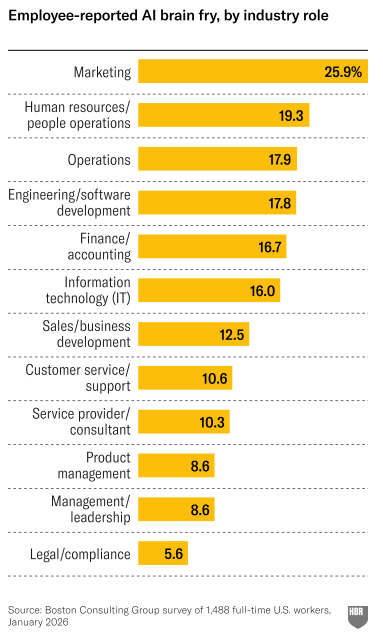
This makes sense.
These are functions where employees are often asked to create, review, coordinate, respond, analyze, and produce at speed. AI can help with many of these tasks. But when employees are managing multiple AI tools at once, the work can shift from “doing the task” to “managing the machine that is trying to do the task.”
That includes asking the right prompt, checking the output, correcting mistakes, comparing versions, validating accuracy, making judgment calls, and deciding whether the tool has actually helped.
This is not always light work. In fact, supervising AI can be mentally demanding because the human is still accountable for the quality of the outcome.
The tool may generate the draft, but the employee owns the decision.
The tool may summarize the document, but the employee owns the interpretation.
The tool may suggest the answer, but the employee owns the risk.
So while AI can reduce effort in one part of the workflow, it can increase cognitive load in another.
Leadership Pressure Can Cascade to Teams
Senior leaders are also under pressure.
As AI becomes embedded across organizations, executives are being asked to demonstrate progress, scale adoption, prove value, manage disruption, and respond to rapidly changing expectations. Research published in Harvard Business Review describes how leaders are navigating continuous disruption, contested definitions of value, and emotionally divided responses to change.
This is an important point.
If senior leaders are struggling to define value clearly, that uncertainty can cascade to teams.
Teams may receive the pressure to “adopt AI” without receiving enough clarity on where AI should be applied, what outcomes matter, what risks are acceptable, what tools are approved, and how success will be measured.
The result is predictable.
Employees start experimenting everywhere.
One team builds an agent. Another starts using a chatbot. Another creates an automation. Another uses AI to draft emails. Another integrates AI into project management. Another creates a knowledge assistant. Another builds a workflow that no one fully understands six weeks later.
So in summary:
- Activity increases.
- Tool usage increases.
- But value does not always increase.
This is how organizations can confuse AI motion with AI progress.
Not Every Problem Needs AI
One of the most important leadership responsibilities today is not simply encouraging AI usage.
It is helping teams understand when AI is useful, when automation is useful, when a simple chatbot is enough, and when AI is not needed at all.
- Some problems do not require AI.
- Some problems require process clarity.
- Some require better data.
- Some require better ownership.
- Some require better communication.
- Some require a simple template, checklist, decision tree, or dashboard.
- Some require a normal conversation between the right people.
- And yes, some problems genuinely require AI.
But if we start with the tool, we risk forcing AI into places where it creates more complexity than value.
The smarter approach is to start with the challenge.
Ask first: What is slow? What is repetitive? What is error-prone? What requires too much manual review? What depends too heavily on one person’s knowledge? What delays decision-making? What reduces quality?
Only after answering these questions should we ask where AI fits.
From AI-First to Problem-First
Organizations need to move from an AI-first mindset to a problem-first mindset.
That does not mean slowing down innovation. It means making AI adoption more mature.
A simple sequence can help:
Challenge → Workflow → Tasks → AI-fit assessment → Tool choice → Human review → Measured value
- Start with the business challenge.
- Then map the workflow.
- Then break the workflow into tasks.
- Then assess which tasks are suitable for AI.
- Then choose the simplest tool that can deliver the value.
- Then define where human judgment is required.
- Then measure whether the work became faster, better, cheaper, safer, or more consistent.
This sequence gives teams focus. It also reduces AI brain fry because employees are no longer asked to use AI everywhere. They are asked to use AI where it makes sense.
Example: Proposal Writing
Take proposal writing as an example.
A proposal process may include several tasks, we show the typical workflow of building a proposal below:
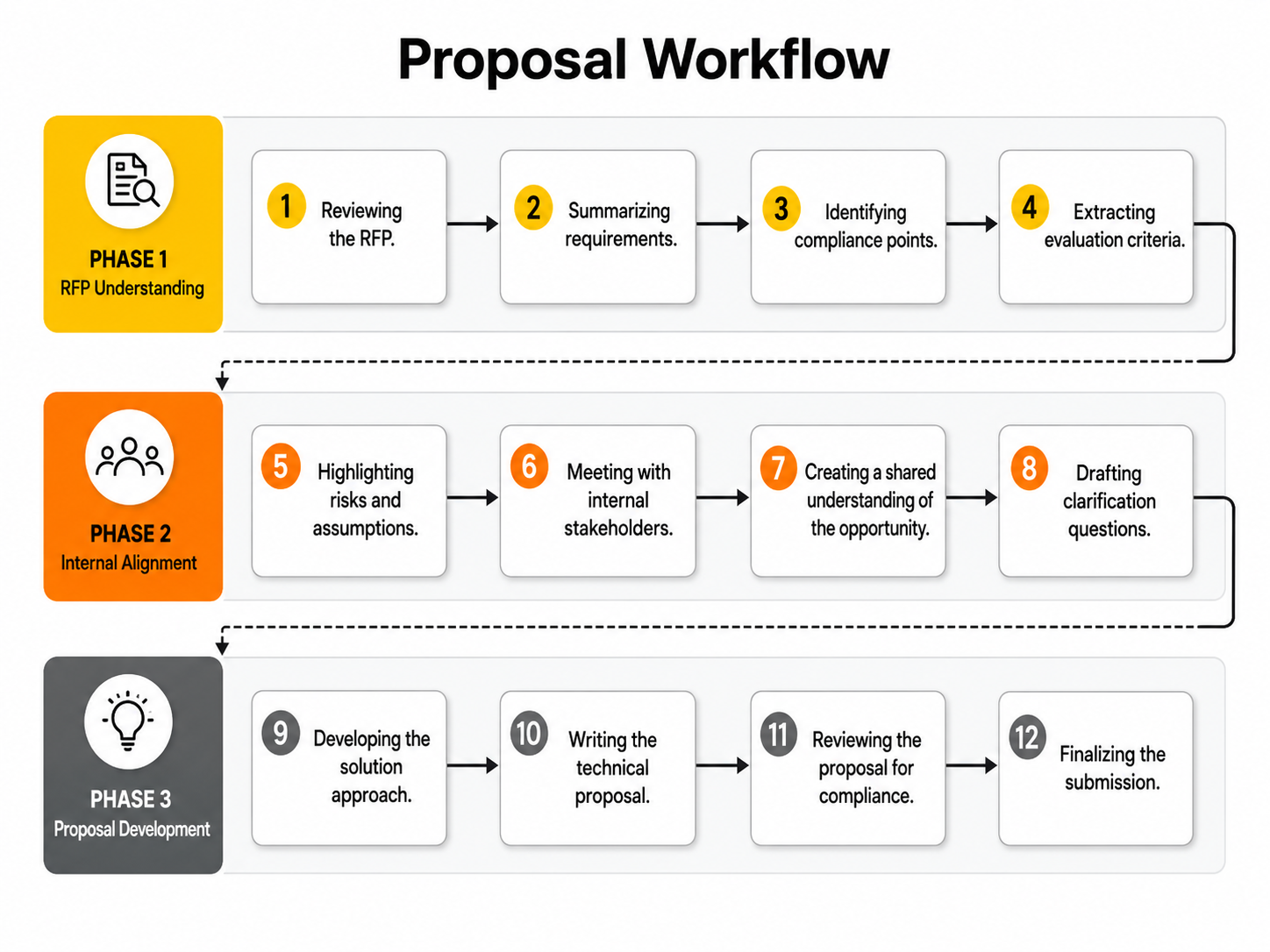
Now, the wrong question would be:
How do we automate proposal writing with AI?
The better question is:
Which parts of proposal writing are slow, repetitive, cognitively heavy, or prone to missed details, and where can AI genuinely help?
AI may be very useful in the first few tasks. It can summarize the RFP, extract key requirements, identify deadlines, create a compliance checklist, draft clarification questions, and prepare an initial briefing for the team.
That alone may save meaningful time. But it does not mean the entire process needs to be automated from day one.
It may not be necessary to build a complex workflow that automatically reads an RFP, drafts an email, sends it to the team, creates tasks, prepares the proposal, and routes it for approval.
Maybe that level of automation will be useful later (and maybe not!)
The point is that the team should not begin with automation. The team should begin with the problem.
- If the biggest pain is that people spend too much time understanding the RFP, then solve that first.
- If the biggest pain is missing compliance requirements, then solve that first.
- If the biggest pain is inconsistent proposal quality, then solve that first.
- If the biggest pain is coordination across multiple contributors, then solve that first.
This creates a practical roadmap. It also allows AI adoption to grow in chunks. The organization does not need to solve the full workflow at once. It can start with two or three high-value tasks, prove value, learn from usage, and then expand.
The Tool Should Fit the Work, Not the Other Way Around
This is also where organizations need to be careful with tool selection.
- Sometimes a simple LLM chat interface is enough.
- Sometimes Microsoft Copilot is enough.
- Sometimes Claude or ChatGPT is enough.
- Sometimes a custom assistant is needed.
- Sometimes a workflow automation tool is useful.
- Sometimes an agentic system makes sense.
- And sometimes AI is unnecessary.
The point is not to use the most advanced tool. The point is to use the most appropriate tool.
A simple chat engine that helps employees read, summarize, and reason through documents may create more value than a complex automation that no one trusts or maintains.
A well-designed prompt library may outperform a poorly designed agent.
A human-in-the-loop process may be better than full automation.
A checklist plus AI summarization may be enough.
The question should always be:
Does this reduce effort, improve quality, accelerate understanding, reduce risk, or support a better decision?
If the answer is unclear, the AI use case is probably unclear.
AI Brain Fry Is a Warning Signal
AI brain fry should not be interpreted as resistance to AI.
In many cases, the people experiencing it may be among the most active users. They are not avoiding AI. They are overloaded by it.
That makes AI brain fry an important organizational signal.
It tells us that adoption is not just about access to tools. It is about the design of work.
If employees are exhausted from managing AI, then leaders should not simply ask them to become better prompt engineers. They should ask whether the work has been redesigned properly.
Leadership questions to ask: Are teams clear on what AI is for? Are use cases prioritized? Are tools consolidated? Are employees trained on when not to use AI? Are outputs reviewed in a practical way? Are workflows simpler or more complicated after AI is introduced? Are we measuring value or just usage?
These questions matter because AI adoption is not successful when employees use more tools. It is successful when work becomes better.
From Adoption Metrics to Value Metrics
Many organizations still measure AI progress through activity-based indicators.
- Number of users.
- Number of prompts.
- Number of licenses.
- Number of tools deployed.
- Number of pilots launched.
- Number of workflows automated.
These measures are not useless, but they are incomplete.
They tell us whether people are using AI. They do not tell us whether AI is creating value.
A more mature organization should ask different questions:
- How much time did we save?
- Which errors were reduced?
- Which decisions became faster?
- Which outputs became better?
- Which risks were controlled?
- Which employees were relieved from repetitive work?
- Which customers or stakeholders experienced better service?
- Which workflows became simpler?
- Which problems were solved?
Without these questions, AI adoption can become performative. Teams may feel pressure to show that they are using AI, even when the value is uncertain.
That is how AI becomes another corporate ritual.
And that is how brain fry spreads.
The Role of Senior Leadership
Senior leaders have a critical role to play.
They do not need to know every AI tool in detail. But they do need to create clarity.
- They need to define the problems that matter.
- They need to clarify what value means.
- They need to avoid rewarding tool usage for its own sake.
- They need to protect teams from unnecessary complexity.
- They need to create room for experimentation, but also discipline around prioritization.
- They need to ask not only “How are we using AI?” but also “Why are we using AI here?”
This shift is important because AI adoption is not merely a technology program. It is a change in how work is designed, governed, measured, and experienced.
If leadership pressure is translated into vague instructions, teams will respond with scattered experimentation.
If leadership pressure is translated into clear priorities, teams can respond with focused innovation.
That difference matters.
Conclusion: The Future Belongs to Problem-First AI Teams
AI brain fry is not a reason to slow down AI adoption.
It is a reason to mature it.
Organizations should not stop experimenting with AI. But they should stop asking teams to use AI everywhere without first defining the problem, the workflow, the value, and the human role.
The best AI strategies will not be built around the largest number of tools. They will be built around the clearest understanding of work.
The future of AI adoption will not be won by the teams using the most tools.
It will be won by the teams that understand their problems clearly enough to know when AI helps, and when it simply gets in the way.
References
Bedard, J., Kropp, M., Hsu, M., Karaman, O.T., Hawes, J. and Kellerman, G.R. (2026) ‘When Using AI Leads to “Brain Fry”’, Harvard Business Review, 5 March.
Boston Consulting Group (2026) ‘When Using AI Leads to “Brain Fry”’, BCG News, 5 March.
Croft, J., Vaid, S., Cheng, L. and Whillans, A. (2026) ‘Where Senior Leaders Are Struggling with AI Adoption, According to Research’, Harvard Business Review, 26 February.
Griffiths, B.D. (2026) ‘Using too many AI tools at once can actually make you less productive and cause “brain fry,” study finds’, Business Insider, 10 March.