10 things that matter in AI right now: MIT Technology Review's 2026 list
AI & Emerging Technology
10 things that matter in AI right now: MIT Technology Review's 2026 list, explained
MIT Technology Review just published its first ever list of the ideas actually shaping AI in 2026, not hype, not forecasts, but what's live right now. It isn't really about the flashiest model release. It's about power, labor, and who is actually in control.
|
DT
|
DataTribes Editorial July 2026 · 6 min read |
Every year brings a fresh wave of "AI predictions" content, and most of it doesn't age well. Give it a quarter and half the list already looks off.
MIT Technology Review took a different approach this year. Instead of guessing what might happen, its editors and reporters focused on what is already reshaping the field: the technologies, power shifts, and backlashes that are live right now, not hypothetical. The result is a list called "10 Things That Matter in AI Right Now," modeled on the outlet's long running Breakthrough Technologies franchise, but built specifically around this exact moment in AI.
Taken together, the ten items sketch a field that has moved past the "will this work" phase and into something messier. It's a technology now embedded in militaries, labor markets, scientific labs, and the information environment itself, with a public that is finally starting to push back.
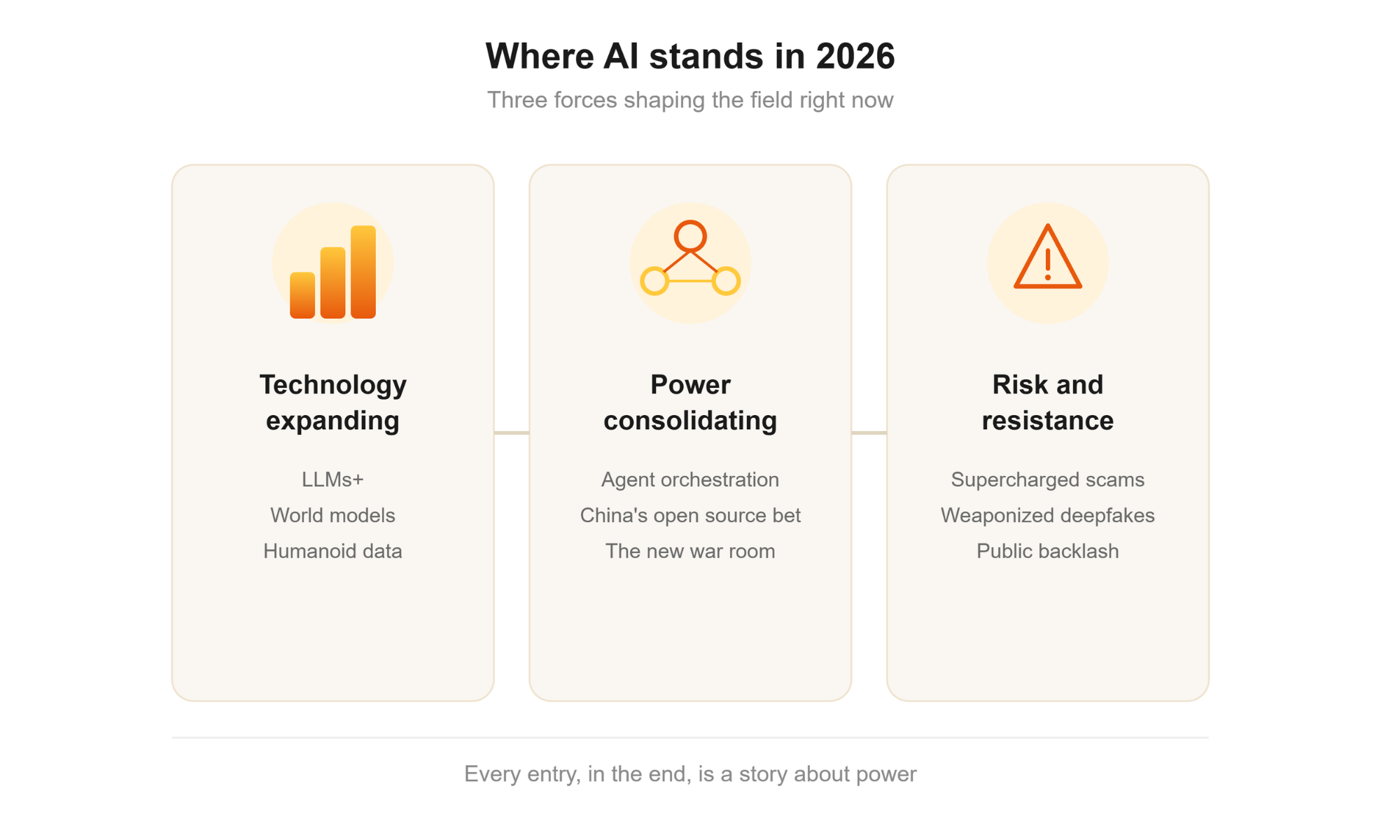
The technology is still expanding
Two entries make it clear that the underlying technology hasn't plateaued.
LLMs+ captures the idea that large language models remain the foundation of the industry even as companies chase "the next big thing." The easy gains may be gone, but according to the report, there's still plenty of juice left to squeeze from the technology.
World models point to where some of that next wave is coming from. AI labs are racing to build systems that understand the physical world rather than just language, trying to move AI out of the chat window and into real environments like robotics and simulation.
That same physical push shows up again in humanoid data, the strange, sprawling effort to collect video of human movement. From dedicated "training centers" to tele operated robots controlled by workers overseas, the goal is to train humanoid robots the same way text once trained chatbots. The report is honest that there's no guarantee this bet pays off.
Power is consolidating in new places
A second cluster of items is less about capability and more about who actually controls it.
Agent orchestration describes the shift from lone AI agents that browse or code in isolation to coordinated teams of agents working toward shared, more complex goals. It's the next step after the first wave of single purpose copilots.
China's open source bet looks at a geopolitical wrinkle worth watching: Chinese labs giving away frontier grade models for free, buying global developer goodwill and credibility in the process. Whether that strategy is financially sustainable is unclear, but one thing is: developers worldwide are already building on top of Chinese foundations.
And in the new war room, generative AI has moved from automating routine military tasks to actually sitting in on decision making, reshaping how militaries share intelligence, partner with Big Tech, and weigh lethal choices.
The risks are no longer theoretical
A third group covers harms that used to be framed as future risks and are now simply happening.
Supercharged scams are the clearest example. AI is lowering both the cost and the skill needed to run a scam or breach a target, which means attacks are getting faster and cheaper to launch at scale.
Weaponized deepfakes get named directly as a threat that has already arrived, not one that's still coming. That's the combination of better generative tools, mass produced nonconsensual imagery, and state use of synthetic media for propaganda.
People are starting to push back
The list closes on two entries that are less about the technology itself and more about how people are reacting to it.
Artificial scientists covers the more optimistic end of the spectrum: autonomous research agents now working alongside human scientists, with some researchers betting these systems could eventually contribute to Nobel level breakthroughs.
Resistance is the counterweight. After years of largely unchecked AI deployment, the report describes a backlash building across an unusually broad coalition of conservatives and liberals, artists and labor unions, and notes that activists are starting to notch real, if small, wins.
Why this list is different
|
10
stories, with no single technology dominating: robotics, LLMs, cybercrime, the military, synthetic media, agents, geopolitics, science, and public sentiment all show up
|
2
companion deep dives, on AI malaise and AI driven mass surveillance
|
1
throughline: nearly every entry, when you look closely, turns out to be a story about power
|
That range is itself the finding. AI's biggest story in 2026 isn't one breakthrough, it's how far the technology has spread into adjacent systems: who trains the data, who commands the agents, who controls the narrative, and who gets to say no.
Conclusion: the story has moved past the model
For a few years, "what's new in AI" mostly meant "what's the newest model." That framing doesn't really capture what's happening anymore. MIT Technology Review's list suggests the more consequential questions now sit one layer up, in labor markets absorbing humanoid robots, militaries integrating AI into command decisions, and a public that is organizing in response.
The technology isn't slowing down. But the conversation about it is finally starting to catch up to its consequences.
References
MIT Technology Review (2026) 10 Things That Matter in AI Right Now, April 2026.
MIT Technology Review (2026) The Era of AI Malaise, by Mat Honan, April 2026.
MIT Technology Review (2026) How LLMs Could Supercharge Mass Surveillance in the US, by Grace Huckins, April 2026.
🔗 Read the full MIT Technology Review list© 2026 Data Tribes. Dubai, United Arab Emirates