Gartner Identifies the Top Trends for Data and Analytics
DataTribes · Data & Analytics Strategy
6 trends reshaping data and analytics in 2026, according to Gartner
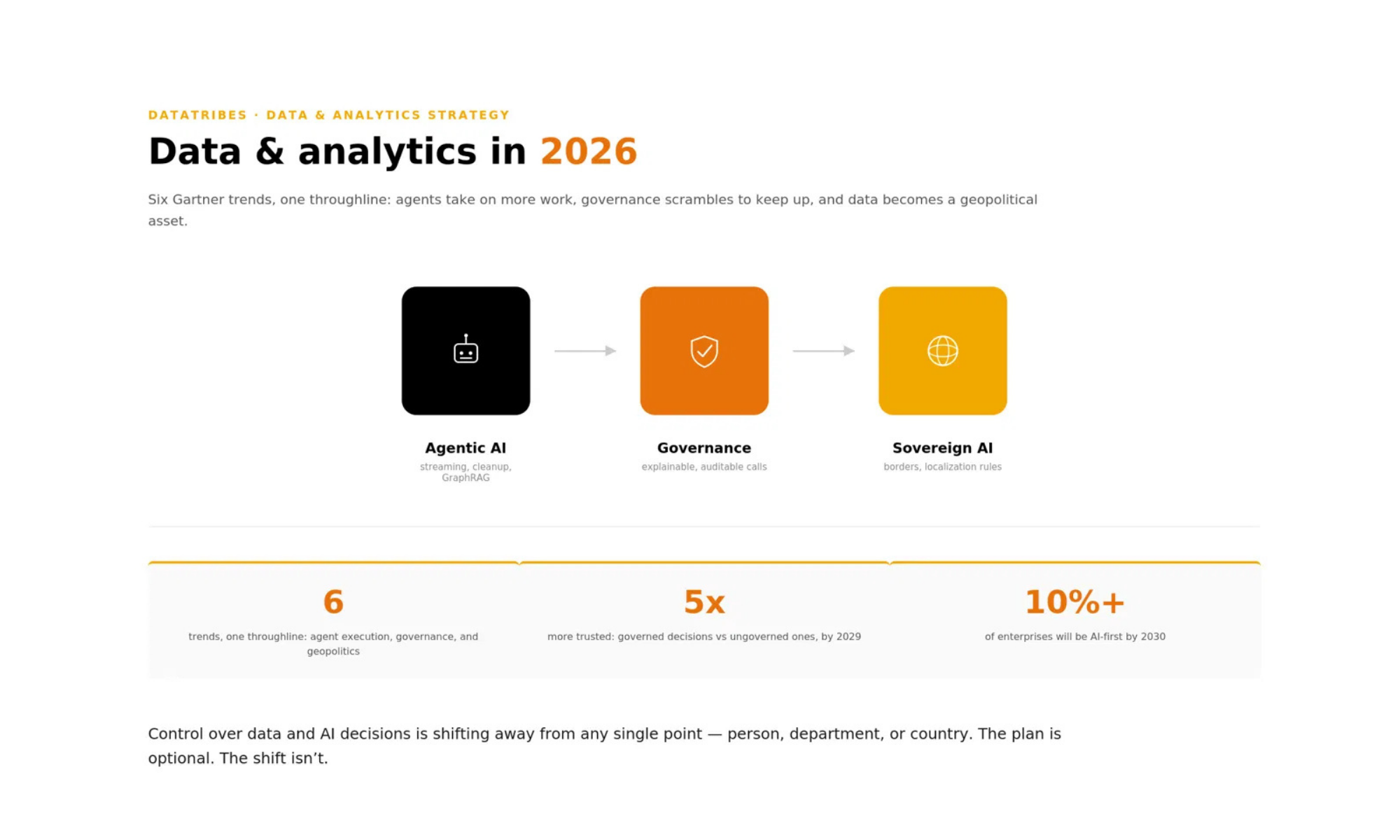
Gartner just laid out where data and analytics leaders should be putting their attention through 2026 and beyond. Agents are taking on real work, governance is scrambling to keep up, and countries are starting to treat data control as a matter of national interest.
Every June, Gartner analysts gather at the Data & Analytics Summit to walk through the trends they think will actually move the needle for the next two years, not just the ones that sound good in a slide deck. This year's edition, presented in Sydney by VP Analyst Carlie Idoine, names six trends. Read them together and a pattern shows up fast: this isn't really a list about new tools. It's a list about who, or what, gets to make decisions.
Agents are doing more of the actual work
Three of the six trends are really about the same shift: AI agents moving from assistants that answer questions to systems that manage data and make calls on their own.
Agentic data streaming is the plumbing behind that shift. Traditional batch processing, where data gets updated in scheduled chunks, is too slow for agents that need to react in real time. Gartner expects adoption of streaming for agentic AI to jump past 60 percent by 2028, up from under 15 percent in 2025. That's the kind of jump that changes how a data team's architecture has to look.
Agentic data management applies that same logic to the unglamorous, constant work of keeping enterprise data clean and usable. Instead of people manually tagging, cleaning, and organizing, AI agents start taking on pattern detection and routine fixes themselves. Idoine notes that this lets teams operate more adaptively, but she's also clear it only works if it's paired with strong oversight, since a self-correcting system that no one is watching can drift in the wrong direction just as easily as it can improve.
Then there's GraphRAG, which tackles a problem anyone who has used an AI assistant has probably run into: it gives you a confident answer that's subtly wrong. Standard retrieval systems struggle with complex, layered questions. GraphRAG pairs knowledge graphs with large language models so the system can hold onto context and relationships, not just keywords. Gartner predicts 40 percent of enterprises will be using GraphRAG techniques by 2029 to improve accuracy and reasoning.
Governance is trying to catch up with all of it
Two trends are direct responses to a simple problem: agents are now making decisions, and most organizations don't have a clear way to explain, audit, or challenge those decisions after the fact.
Decision governance is Gartner's answer to that gap. It takes the discipline that used to sit around human decision making and applies it to automated ones, so that a decision an AI agent makes is explainable and traceable rather than a black box. The upside Gartner cites is striking: explicitly modeled decisions are projected to be five times more trusted and 80 percent faster than ungoverned ones by 2029.
AI governance platforms operate a level up from that. As more countries introduce their own AI rules and more agents get deployed without much oversight, the old approach of case by case assurance reviews stops scaling. Governance platforms centralize oversight, apply risk frameworks consistently, and enforce policy across an organization rather than leaving it to individual teams to figure out on their own.
Data is becoming a geopolitical asset, not just a technical one
The last trend stands a bit apart from the rest, because it's less about what's happening inside a company and more about what's happening between countries.
Sovereign AI describes the growing push from nation states to control their own AI infrastructure and reduce dependence on other countries. For data and analytics leaders, that's not an abstract policy debate. It shows up as new localization requirements, new restrictions on where data can live, and new questions about which AI platforms a company is even allowed to use in a given market. Idoine frames it as something that changes how organizations have to roadmap their AI strategy altogether, since a use case that works in one jurisdiction might not be viable in another.
Why this list matters
|
6
trends, one throughline: agentic streaming, agentic data management, GraphRAG, decision governance, AI governance platforms, and sovereign AI
|
2
trends focused directly on governing AI decisions, decision governance and AI governance platforms, both built to keep autonomous systems accountable
|
1
trend rooted purely in geopolitics, not technology: sovereign AI shows D&A strategy now has to account for national borders too
|
Look past the individual names and the six trends really tell one story: control over data and AI decisions is shifting away from any single, central point, whether that's a person, a department, or even a country. Organizations without a plan for that shift will end up reacting to it instead of shaping it.
The takeaway for data teams
None of these six trends is about picking a flashier model or a bigger platform. They're about infrastructure, oversight, and geography catching up to how fast agentic AI has already moved into daily operations. Gartner's framing is blunt: more than one in ten enterprises will be AI-first by 2030, and the ones that get there will be the ones that built agents, semantics, and governance into their strategy early, not the ones that bolted it on afterward.
For data and analytics leaders, the practical question isn't whether to adopt agents. That's already happening. It's whether the governance and infrastructure around those agents are strong enough to trust the decisions they're making.
References
Gartner (2026) Gartner Identifies the Top Trends for Data and Analytics, June 16, 2026.