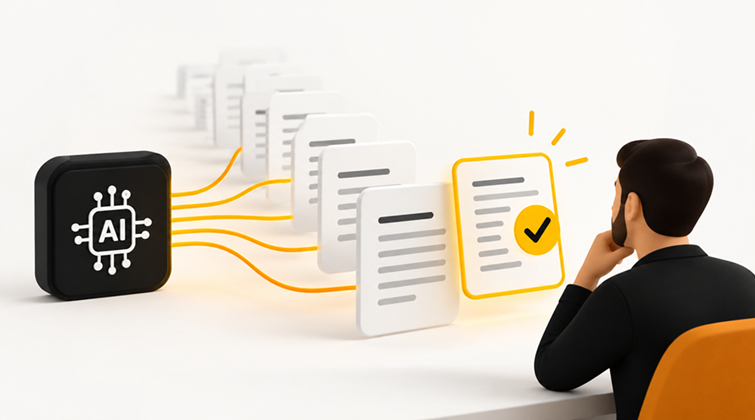
AI Is Making Verification the Bottleneck for Companies
Curated by Data Tribes | Based on insights by Christian Catalini, originally published in Harvard Business Review.
AI is making it dramatically easier to generate work.
Documents can be summarized in seconds. Code can be produced at speed. Reports, recommendations, analyses, and even decisions can increasingly be supported or executed by AI.
But as the cost of producing work falls, another challenge becomes more important:
How do we know whether what AI produced is actually correct, appropriate, and trustworthy?
This is the central argument behind Christian Catalini’s analysis: as AI makes execution cheaper and faster, verification increasingly becomes the bottleneck.
And that shift has major implications for how organizations think about automation, expertise, data, governance, and competitive advantage.
AI Has Changed the Economics of Work
Organizations have always needed people to do more than simply execute tasks. Managers and domain experts also interpret information, coordinate work, challenge assumptions, review outputs, and decide what deserves attention.
AI is increasingly capable of taking on parts of the execution and coordination layer. It can retrieve information, process large volumes of context, generate outputs, and automate repeatable tasks at a speed that would previously have required significant human effort.
But execution is only half of the equation.
The shift: When producing an answer becomes cheap, determining whether that answer can be trusted becomes more valuable.
This is why Catalini describes organizations as potentially becoming “verification factories”: organizations that become exceptionally good at steering AI, checking its outputs, learning from mistakes, and standing behind the resulting decisions.
The Verification Gap
AI performs particularly well when the objective is clear, the necessary information is available, and success can be measured.
The difficulty begins when the AI does not have all the context that a human expert brings to the problem.
Think about writing a prompt and realizing halfway through that you forgot an important constraint. You knew the constraint mattered, but you did not initially state it because it felt obvious.
Organizations face the same problem at a much larger scale.
Experienced employees carry years of knowledge that may never have been formally documented:
- Why a similar initiative failed five years ago.
- Which customer signals deserve attention.
- Which regulatory interpretation creates risk.
- Which unusual pattern normally indicates a problem.
- When an answer looks technically correct but still does not make business sense.
This is often called tacit knowledge: expertise accumulated through experience but not necessarily captured in databases, documents, or business rules.
The real question is not only “Can AI perform this task?” but also “Can we reliably verify the result?”
Not All AI Automation Carries the Same Risk
A useful way to think about AI adoption is to evaluate a task across two dimensions:
- How easy is the task to automate?
- How easy is the AI-generated output to verify?
Combining these questions gives organizations a simple way to think about where AI autonomy makes sense and where human expertise remains essential.
| EASY TO VERIFY | HARD TO VERIFY | |
|---|---|---|
| EASY TO AUTOMATE |
✓ Safe Industrial Zone
Strong candidate for autonomous AI. Outputs can be generated and checked efficiently.
|
⚠ Runaway Risk Zone
AI can produce outputs faster than people can reliably validate them. Strong oversight is critical.
|
| HARD TO AUTOMATE |
Artisan Zone
Human execution remains important, although the resulting work can be checked relatively easily.
|
Expert Verifier Zone
Both execution and verification depend heavily on specialist knowledge and human expertise.
|
Adapted and simplified by Data Tribes from the automation and verification framework discussed by Christian Catalini and coauthors.
The most important area is the Runaway Risk Zone.
Here, AI can generate work very cheaply and very quickly, but determining whether the result is correct still requires significant human expertise.
This creates a dangerous imbalance: generation can scale much faster than verification.
An organization may therefore appear to become dramatically more productive while simultaneously producing more outputs than its experts can meaningfully review.
Why Human Expertise Still Matters
One of the most important warnings in the original analysis is that organizations should be careful not to automate away the expertise they still need to verify AI.
Good managers and experienced specialists do much more than route information. They determine what matters, challenge assumptions, recognize unusual situations, and decide whether an output meets the organization’s quality bar.
Imagine an experienced engineer reviewing an AI recommendation. Everything appears correct according to the available data, yet something reminds the engineer of a previous failure.
The concern may initially be difficult to articulate. But that hesitation itself may contain valuable knowledge that the AI system does not possess.
If organizations progressively remove experts from these decisions, they risk creating systems that are highly efficient at repeating what the organization already knows while becoming less capable of recognizing something genuinely new.
Key principle: AI should help experts make better decisions and capture their knowledge — not gradually remove them from the experiences that created their expertise.
Turn Every Correction Into a Learning Opportunity
This leads to perhaps the most practical lesson for organizations.
Whenever an expert accepts, corrects, rejects, or overrides an AI recommendation, that interaction contains valuable information.
Instead of allowing those moments to disappear, organizations should build a learning loop around them.
A healthy verification loop captures more than whether the AI was “right” or “wrong.”
It should capture:
- What information the AI used.
- What recommendation or action it produced.
- Whether the expert accepted, corrected, or rejected it.
- Why the expert intervened.
- What eventually happened in the real world.
- What the organization should learn from the outcome.
Over time, these corrections can become extremely valuable organizational knowledge.
Your Data and Feedback Are Strategic Assets
There is another important dimension to verification: ownership.
As organizations use external AI platforms, agents increasingly interact with internal documents, conversations, codebases, workflows, and business systems.
The resulting feedback can reveal something extremely valuable: how the organization actually makes decisions.
Which recommendations do experts reject? Which exceptions matter? Which information changes a decision? What sequence of actions works? When does someone escalate?
These operational traces can represent part of an organization’s competitive knowledge.
This means AI governance must increasingly consider not only privacy and security, but also:
- Who owns the feedback generated by AI interactions?
- What information can technology providers retain?
- Can operational traces be reused?
- Where should proprietary knowledge and corrections be stored?
- How can the organization maintain control over its learning loop?
Organizations do not necessarily need to build every AI capability themselves. But they should understand which parts of their data, expertise, and feedback create strategic differentiation — and ensure those assets remain under appropriate control.
Data Tribes Perspective: Good AI Needs Good Verification
At Data Tribes, we often emphasize a simple principle:
Good AI starts with good data.
The verification challenge reinforces that principle — and extends it.
AI cannot be reliably verified without trustworthy reference points. Data quality, metadata, business rules, governance, lineage, domain knowledge, and clearly defined outcomes all help organizations determine whether an AI-generated result deserves to be trusted.
But verification also creates new data.
Every time an expert corrects an AI recommendation, identifies missing context, challenges an assumption, or overrides an automated decision, the organization has an opportunity to capture knowledge that may previously have existed only in someone’s experience.
Our takeaway: Good AI starts with good data — but reliable AI also requires good verification. The organizations that succeed will not simply generate more with AI; they will become better at knowing what to trust, learning from what goes wrong, and turning human expertise into organizational knowledge.
What Leaders Should Ask
As organizations accelerate AI adoption, a few questions become increasingly important:
| Question | Why It Matters |
|---|---|
| Can we verify what AI produces? | Automation without reliable verification can scale errors as quickly as it scales productivity. |
| Where does critical knowledge still live only in people? | Tacit expertise may contain context that AI systems cannot yet access. |
| Are expert corrections being captured? | Corrections can become valuable data for improving future decisions. |
| Are we measuring real-world outcomes? | A plausible AI answer is not necessarily a successful business outcome. |
| Who owns our AI learning loop? | Proprietary feedback and operational knowledge may become an important competitive asset. |
Final Thought
The AI conversation has largely focused on what machines can generate and automate.
But as those capabilities become cheaper and more widely available, competitive advantage may increasingly move somewhere else.
It may lie in an organization’s ability to recognize when AI is wrong, understand why, capture the lesson, and improve the next decision.
The question for leaders therefore becomes less about how much AI can produce and more about how confidently the organization can stand behind what it produces.
When one of your experts overrides AI, is that correction captured — and does your organization own what it learns from it?
Source & Attribution
This Data Tribes article is a curated and simplified interpretation of “AI Is Making Verification the Bottleneck for Companies” by Christian Catalini, published by Harvard Business Review.
Christian Catalini is the founder of the MIT Cryptoeconomics Lab and a research scientist at MIT. The concepts, arguments, and original verification framework discussed in this article originate from Catalini’s work and the research referenced in the original publication. Data Tribes has summarized and reorganized the ideas for accessibility and added its own perspective on data, governance, and AI adoption.