The C-Suite Behaviors That Stall AI Transformations
Curated by Data Tribes | Based on insights by Amii Barnard-Bahn, originally published in Harvard Business Review on October 23, 2026.
An organization can have a compelling AI strategy, a capable technology team, and a promising roadmap — and still struggle to turn its ambitions into results.
Why? Sometimes, the obstacle is not the AI itself. It is the way leaders make decisions, protect responsibilities, and work across departments.
In her Harvard Business Review article, Amii Barnard-Bahn explains how two familiar executive behaviors can undermine AI initiatives: claiming too much ownership and avoiding responsibility for decisions that seem to belong to someone else.
AI crosses functional boundaries. If leadership remains confined within those boundaries, even strong AI initiatives can stall.
Why AI Challenges Traditional Leadership Models
Most executive teams are structured around functional responsibilities. The CIO manages technology. The CHRO leads people and talent. The CFO safeguards financial priorities. Legal and risk leaders protect the organization from exposure.
That division of responsibilities makes sense for many activities. AI, however, rarely stays inside a single function. An AI initiative might be technically feasible but demand workforce reskilling, change operational workflows, introduce new compliance questions, and alter cost structures — all at once.
Consider a technology executive who develops an AI implementation roadmap without involving HR early. The technology plan may be excellent, but the organization could discover too late that its people are unprepared for the change. What looked like a technology rollout becomes an organizational conflict.
Barnard-Bahn describes this increasingly contested decision-making environment: several executives have legitimate interests in the same AI initiative, yet no single function has the complete picture.
The leadership shift: From protecting functional territory to jointly shaping decisions and being accountable for enterprise outcomes.
The Two C-Suite Behaviors That Backfire
The article identifies two opposing behaviors. They may look very different, but both prevent the cross-functional cooperation that AI demands.
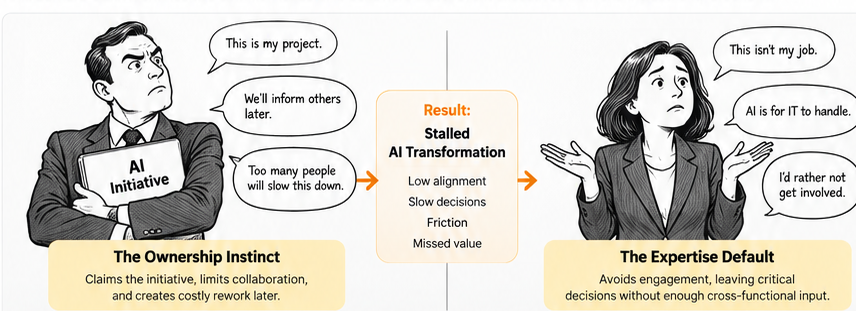
01. The Ownership Instinct: “My Idea, My Project”
Senior executives often advance by taking charge and delivering results. But when that instinct becomes territorial, an AI initiative may be designed within one function and presented to others only after important decisions have already been made.
The consequences include overlooked requirements, conflicting priorities, costly redesigns, and resistance from teams expected to implement a plan they did not help shape.
One example in the original article describes a global bank where a promising AI prototype was abandoned after its technology vendor came into conflict with another executive's cost-reduction mandate. Each function was pursuing a legitimate objective, but the enterprise-level trade-off had not been resolved collaboratively.
02. The Expertise Default: “This Isn't My Job”
The opposite problem occurs when executives leave AI decisions entirely to technology leaders. Some assume they lack sufficient technical knowledge; others engage only to raise concerns from their own function.
Yet an HR leader does not need to build an AI model to evaluate workforce implications. A legal leader does not need to become a data scientist to assess privacy or accountability. Their expertise is essential precisely because AI has consequences beyond the technology.
Disengagement creates blind spots just as surely as excessive control does. The problem is not that every executive must become an AI expert; it is that every executive must understand enough to participate responsibly.
What both behaviors have in common: They replace collective judgment with a partial view of the problem. One leader holds on too tightly; another steps away too quickly.
Five Practices to Keep AI Transformation Moving
Barnard-Bahn outlines five practices that help executive teams replace territorial behavior with shared authority. Their value lies in changing how leaders work together, not simply adding another governance committee.
| Practice | What It Looks Like in Practice |
|---|---|
| 01 Define the problem first | Agree on the business outcome, scope, risks, and human role before deciding who owns the initiative. |
| 02 Invest in relationships | Build trust between technology, HR, operations, finance, and risk leaders before high-stakes disagreements arise. |
| 03 Expect iteration | Treat early plans as informed experiments. Learn, adjust, and avoid defending an initial position at all costs. |
| 04 Build joint incentives | Reward shared business outcomes, not only the performance of each individual function. |
| 05 Adopt a friction framework | Define how disagreements are raised, who makes the final call, and when escalation is necessary. |
The final practice is particularly important. Cross-functional collaboration does not eliminate disagreement, nor should it. Different leaders are expected to see different risks. The goal is to make those differences visible, constructive, and resolvable before they halt progress.
From Functional Turf to Shared Authority
A crucial distinction: shared authority does not mean everybody owns every decision. An organization can assign one executive to coordinate its overall AI agenda while defining different decision rights for each initiative, according to its impact and the expertise required.
The CEO's responsibility is not to settle every AI dispute personally. It is to establish an environment where the right executives can work through decisions together, with clear accountability and a shared commitment to business results.
Data Tribes' simplified application of the article's five leadership practices
A recurring leadership discipline, not a rigid one-time sequence.
Data Tribes Perspective: AI Governance Is Also a Leadership Challenge
At Data Tribes, we frequently emphasize that good AI starts with good data. Data quality, governance, architecture, and responsible access remain essential foundations for reliable AI.
But this article highlights another dimension of readiness that organizations can underestimate: their ability to make coordinated decisions.
An organization may establish a data governance council, adopt an AI platform, define technical standards, and launch several use cases. Yet if business, technology, people, legal, and risk leaders do not have clear ways to make decisions together, those investments may still struggle to deliver enterprise-wide value.
From our perspective, AI governance should therefore address not only what systems are permitted to do, but also how people decide what those systems should do. This includes clear sponsorship, decision rights, shared measures of success, and escalation paths that resolve real trade-offs rather than simply moving them between departments.
Our takeaway: Good AI starts with good data. But successful AI transformation also needs good leadership coordination — where authority is clear, decisions are shared when necessary, and organizational outcomes matter more than departmental ownership.
What Executive Teams Should Ask
Before launching the next AI initiative, executive teams can challenge themselves with four practical questions:
- Are we aligned on the business problem — or have we already begun competing over ownership of the solution?
- Which functions will be affected — and were their leaders involved before the major decisions were made?
- Who decides what when technology feasibility, workforce impact, financial value, and compliance point in different directions?
- Are we rewarding enterprise value — or only individual departments for meeting their own targets?
Final Thought
The companies that move fastest with AI may not always be those with the most sophisticated models or the largest technology budgets.
They may be those whose leaders know when to take charge, when to bring others in, and how to resolve disagreements without turning every decision into a contest for territory.
If an AI initiative touches five functions, do your five executives see one shared business opportunity — or five competing priorities?
Source & Attribution
This article is an independently curated and simplified interpretation of “The C-Suite Behaviors That Stall AI Transformations” by Amii Barnard-Bahn, published in Harvard Business Review on October 23, 2026. The central leadership behaviors and five recommended practices originate from the original article. The editorial structure, illustrations, practical workflow, and Data Tribes perspective are our own.
Read the original Harvard Business Review article.